Self-Service PDF-to-Word Conversion: An Alternative to Universal Adobe Acrobat Licensing
The licensing problem Link to heading
Adobe Acrobat Pro is the default answer whenever an organisation needs to convert PDF documents to editable Word files. It is also expensive at scale: a per-seat licence for every employee who occasionally needs a converted document is a large recurring cost, and most of that spend goes towards editing and authoring features the majority of users never touch. For one of the clients I supported, the actual requirement across the business was narrow: turn a PDF into an editable Word document, occasionally, from anywhere in the organisation.
Rather than licensing Acrobat for everyone, I designed and built a self-service conversion pipeline on Azure that any employee worldwide can use for free, and reserved paid Acrobat licences for the smaller group of users, for example the finance department, who genuinely need full PDF editing and authoring capability rather than a one-off conversion.
Solution design Link to heading
The service is entirely email-driven: a user attaches a PDF to an email sent to a dedicated shared mailbox and receives the converted Word document back, with no client software, portal login or training required.
An Azure Logic App handles the workflow: it triggers on new mail, saves the attachment to Blob Storage, and orchestrates a set of Azure Functions written in Python:
- Validation function computes an MD5 hash of the attachment and checks Azure Table Storage for a matching file, so the same document is never converted twice. It also rejects encrypted or copy-protected PDFs before any conversion is attempted.
- Conversion function performs the PDF-to-Word conversion using the Apryse (PDFTron) Core SDK and writes the result back to Blob Storage, recording the requester’s email and document name in Table Storage for auditing.
- Retention function runs on a daily schedule and removes converted files older than 30 days, keeping storage costs predictable without manual housekeeping.
- Health check function exposes an unauthenticated endpoint so the service’s availability can be monitored independently of the conversion workload.
The Function App runs production and staging deployment slots, with Azure DevOps building and deploying changes to staging first and swapping to production only once verified, so the conversion workflow is never disrupted mid-release.
A conditional access policy on the shared mailbox rejects any email arriving from outside the organisation’s own domain, so the conversion pipeline only ever processes attachments from verified internal senders.
Licensing economics Link to heading
The only paid component in the entire pipeline is a single Apryse SDK licence attached to the Function App, which converts documents for the whole organisation. That one licence replaces what would otherwise be hundreds or thousands of individual Acrobat seats, while the Acrobat budget that remains is spent precisely where it is needed, on the finance team and other users who edit PDFs directly rather than just converting them.
Usage in production Link to heading
The service has been running in production since 2024 and is used worldwide, with no regional restriction on who can send a PDF to the mailbox.
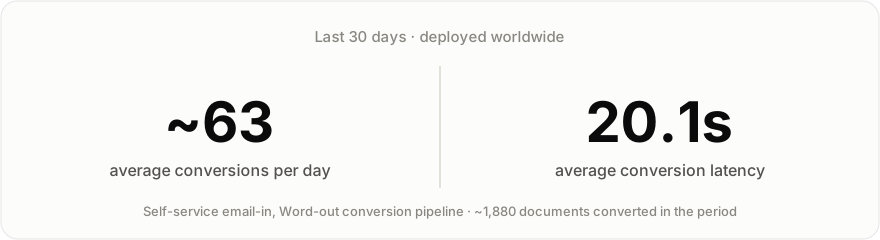
The 30-day average of around 63 conversions a day, at an average latency of 20.1 seconds per document, has held steady since launch, confirming that a single serverless conversion function comfortably covers organisation-wide demand without the per-seat cost of a universal Acrobat rollout.